Goals & Steps
Break large goals into workable steps, execute daily, and keep visible evidence of progress.
Who this is for
Members actively working through one or more engaged goals and needing structure for day-to-day execution.
Step-by-step
- The main goals page now stays visually simple for smaller goal lists. If you have 8 goals or fewer, Goaliath shows the full list without search, pagination, or advanced filters.
- If your goals list grows beyond 8 items, Goaliath keeps the list in one place and reveals more items with Show more goalsinstead of sending you through numbered pages.
- Goal cards and table rows now treat the step path as the main action. Use Continue goal to open the plan directly, while notes, calendar, videos, completion, and delete stay as secondary tools.
- The goals page summary now gives a portfolio view across Total goals, Engaged now, Planned next, and Completed.
- By default, goals are now grouped into Engaged now, Planned next, and Completed so you can scan your whole goal portfolio without mixing every state together.
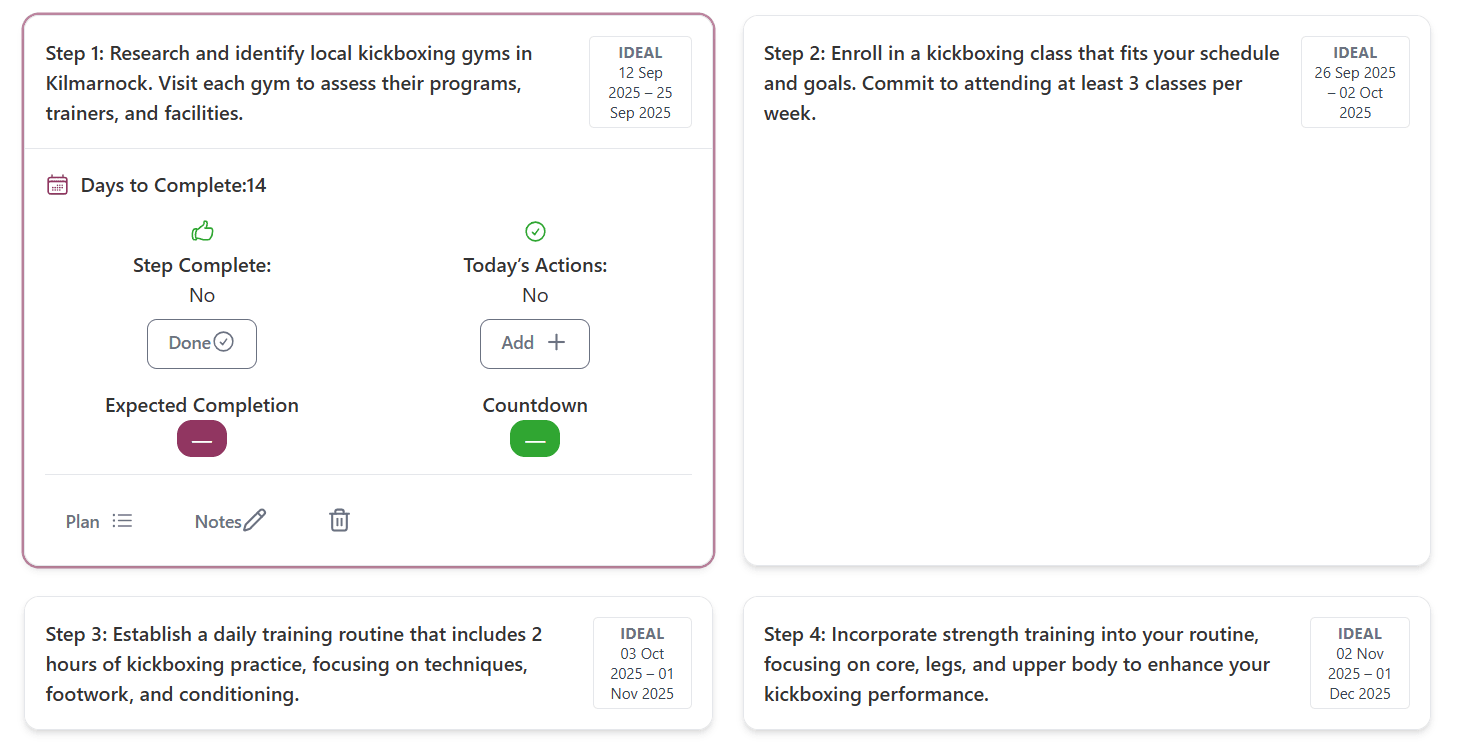
- Open a goal and review step order, durations, and current status.
- Goal details now stay focused on execution. Goal Stack settings are handled outside the steps view so built-in tool choices do not crowd the main plan.
- If Goaliath offers to break a goal step into action steps or an action step into todos, review the mobile-friendly modal and confirm only when the next layer looks useful.
- When the Goal Planner creates a new goal, Goaliath now activates the first high-level step, the first action step under it, and the first uncompleted todo under that action step. Today's Actions and dashboard focus then prefer the deepest ready item first.
- If that active path ever becomes inconsistent later, the scheduler now repairs it automatically by restoring the deepest valid next item instead of leaving an engaged goal without a clear next action. If you manually remove a suggested item from Today's Actions, Goaliath now respects that choice and skips to the next valid item instead of forcing the same one back in.
- Free Basic accounts can still work through existing goals manually, but AI actions such as generating sub-steps, generating todo sequences, and opening Goal Assist, Action Assist, or Todo Assist now open an upgrade modal instead of attempting the AI action.
- Move the next 1-3 high-impact items into Today's Actions.
- If you previously engaged a goal but chose not to start the seeded first task, look for Resume your first move on the goal page to reopen that same workspace later.
- Complete work and log evidence (note, link, or upload).
- Mark daily completion or full-step completion as appropriate.
- Completed action steps and completed todos now switch to a positive completion state. You will see Completed on with the local date and time instead of an expired countdown label.
- The main green Work now button stays on the next active added step or todo, while completed items can still be reopened from the ... menu.
- Completed items also stop showing the inline Add to Today's Actions control, even if their status chip still shows where they were previously active.
- Goal card completion now rolls up through the tree, so completing a todo or action step can move the main goal percentage before a full high-level step is finished.
- When you complete work from a Start Now workspace, Goaliath now returns you to the relevant action-step or todo level instead of sending you back to the top-level goals list.
- Engaged goals now expose a clickable Primary or Secondary pill. Press it to open a small modal where you can swap the goal's focus role without re-engaging the whole goal.
- Buttons such as View sub-steps now show a loading state immediately after you press them, so you can see the next page is opening.
- On mobile, both the page action bars and the in-card action rows now use the same compact button language, so controls such as view sub-steps, create repeatable plan, view todo, and overflow menus stay on one cleaner row.
- The high-level steps, action-step, and todo pages now keep their parent Back button in the same top-right header area, next to the ring view button, so moving between levels feels more consistent on mobile.
- The high-level steps and action-step headers now use the same right-side control order: ring view first, the duration in days second, and the compact back button last.
- The high-level steps progress strip now matches the action-step page more closely, showing percentage complete on the left and completed-step count on the right instead of the old started-date badge.
- Implementation intention cards now follow one rule across high-level steps, action steps, and todos: they only appear when the cue is active in the current planned work window, instead of appearing more loosely on some lower-level pages.
- The action-step cards inside Action path now use the same split deadline panel as the main high-level and action-step cards, instead of showing separate expected-completion and countdown pills.
- The Action path section now also follows the high-level steps template more closely with the same divider-led sequence layout, calmer item styling, and the same action-row placement logic.
- On mobile, when you press Utilities, the original top action row is replaced by a compact inline utility row, so Fitbit tools, progress log, and close are easier to tap and easier to see.
- The small ... action buttons inside goal, action-step, and todo cards now use the same full bordered button treatment as the other mobile utility buttons, and on mobile they switch the row into a compact action mode with small buttons plus a close button instead of opening a harder-to-see floating menu.
- In mobile Gantt view, long step names now collapse down to Step 1, Step 2, and so on, and tapping a step opens a modal with the full description and target window so the timeline bars stay visible sooner.
- The primary step cards now combine Expected Completion and Countdown into one split timing card with a divider, so deadline context stays together instead of feeling like two disconnected boxes.
- The high-level step, action-step, and todo pages now put the current item first with a Focus now card, while the full path and batch add controls stay collapsed under plan-management sections until you need them.
- The goal-step, action-step, and todo headers now keep the Back button at the top-right of the summary card, and the visible ring control is now the live goal ring itself instead of a plain text button.
- When you complete a task, the evidence modal can also ask how that progress felt so Goaliath can learn which actions feel more meaningful to you.
- When a completion modal asks for time spent, it now starts with the best trustworthy duration Goaliath knows for that item, such as planned, scheduled, or estimated time, and you can still edit it up or down.
- If a completion save fails, Goaliath now keeps the message plain and asks you to try again instead of showing raw technical database text.
- Use the mini ring on dashboard goal cards and focus cards to open goal-specific ring details for today.
- If you log completed goal time from a dashboard focus card, that goal's ring and time balance update even when no separate step or todo is scheduled underneath it.
- After a planned goal session ends, the focus card first shows an Awaiting log state for a short grace window. Later the same day, unresolved sessions switch to a warning-icon recovery prompt that opens a modal with the next action choices.
- The dashboard Focus area now has Focus now and Recover today tabs, so unresolved earlier goal sessions stay visible after the next focus block takes over.
- Recover today now also suggests the right next move based on recent pattern: simple confirmation, same-day finish, shrink or move, or deeper plan repair.
- When Goaliath sees a clear pattern behind the slip, Recover today can also point you straight to the most relevant support tool, such as Implementation Intentions for cue timing, Mental Contrasting (WOOP) for recurring obstacles, or Identity Statements for recommitment.
- Those recovery tool links are now reuse-first. If the goal already has a linked identity statement, implementation intention, or WOOP entry, Goaliath opens the existing one for review or editing instead of defaulting to a duplicate create flow.
- Use the balance strip under the goal rings to see whether this goal is ahead, behind, or on track for the week.
- Desktop goal cards now keep their action buttons aligned more consistently, and long next-step previews are shortened so the grid stays easier to scan.
- Goal cards now show the timeline as a labeled duration, such as 1 month or 6 months, instead of a bare number.
- Review completed items weekly and adjust the upcoming sequence.
What good looks like
- Only a small number of active items are in Today's Actions.
- Evidence is logged consistently, not only when things go well.
- Each goal has a daily ring view so you can see time, task-slice progress, and execution health at a glance, including tracked recovery after missed work.
- Each goal also shows planned versus actual time so you can see the goal's running weekly balance without guessing.
- Dashboard goal cards and focus cards use the same smaller ring icon on the left, and clicking it opens the detailed goal-specific ring modal.
- Shrink can now create a smaller todo before the current todo, so the original work stays in the sequence without blocking today.
- Recovery actions such as Recommit and Redesign can also be recorded directly from Today's Actions.
- Scope is adjusted quickly when planned versus actual drifts.
- Primary goal stays clear and secondary goals remain limited.
Common issues and fixes
- Plan feels too large: reduce active goals and shorten daily load.
- Missing evidence history: use completion modal for every done action.
- Step timing feels off: edit durations and regenerate lower-level tasks.
- Looking for search or filters on the goals list: they appear only when your goal list grows beyond 8 items and actually needs extra management controls.
- Looking for another page of goals: use Show more goals. Goaliath now extends the current list instead of opening a separate numbered page.
- Looking for one combined goals list: if you apply a status or engagement filter, Goaliath temporarily returns to a single filtered list so the filter results stay straightforward.
- Looking for Work now on a completed step: open the... menu. The visible green button only stays on the next unfinished active item.
- Looking for the old small details shortcut: the main path is now the larger Continue goal button, shown next to the next-step preview.
- Changed a goal from Primary to Secondary and it would not save: Goaliath requires one engaged goal to stay primary, so you must choose a replacement primary before demoting the current one.
- Deleted a goal and expected to stay on the current page: goal deletion now returns you to the same workspace where you pressed delete, such as Dashboard, Goals, or Goal Planner.
Related help
Documentation details
- Last updated: July 1, 2026
- Doc owner: Product Documentation Team
Screenshot slot