Calendar
Protect time for your priorities by turning plans into scheduled commitments.
Who this is for
Members who want to reduce drift by blocking focused work sessions and resolving schedule conflicts quickly.
Before you start
- Connect Google or Microsoft calendar from Integrations.
- Connect and sync Fitbit from the Performance page (not Calendar).
- Confirm your local timezone in Profile Settings.
- Create or engage at least one goal so sessions can be scheduled.
Step-by-step
- Open Calendar and connect your provider if not connected.
- Schedule goal sessions or tasks from Goals or Today's Actions.
- Use Calendar AI suggestions to resolve overlaps or overbooked days.
- Use the Allow overlaps toggle in Calendar AI (default Off) to keep no-overlap scheduling unless you explicitly enable overlaps.
- When no-overlap mode is Off, direct Quick add and Add/Edit event flows also enforce this rule and show a friendly conflict message with options to move, replace, or allow once.
- Use Mind unload to capture tasks fast, edit draft cards, and schedule or keep items unscheduled.
- Use the Live calendar thread on the right on desktop. On mobile, open Calendar AI as a modal so the chat does not sit underneath the calendar grid.
- For scheduling requests, Calendar AI may place a pending draft block on the calendar first so you can see placement instantly, then you can Confirm, Edit, or Cancel. Recurring drafts preview upcoming occurrences in the next 7 days.
- Switch thread modes from the embedded tabs (Chat, Mind unload, Baseline, Gaps). Each mode keeps a separate thread and reset behavior.
- On desktop, Calendar uses a dedicated workspace shell: the left rail stays icon-only on this page, the shared dashboard top bar is removed, and the calendar controls sit in one compact toolbar above the canvas so more of the screen stays available for planning.
- Use the Show AI / Hide AI arrow button to collapse the right panel and expand the calendar to full width when you need more planning space.
- Use the single in-calendar Agenda view (Today or Next 7 days) with search and type filters, instead of a separate agenda panel.
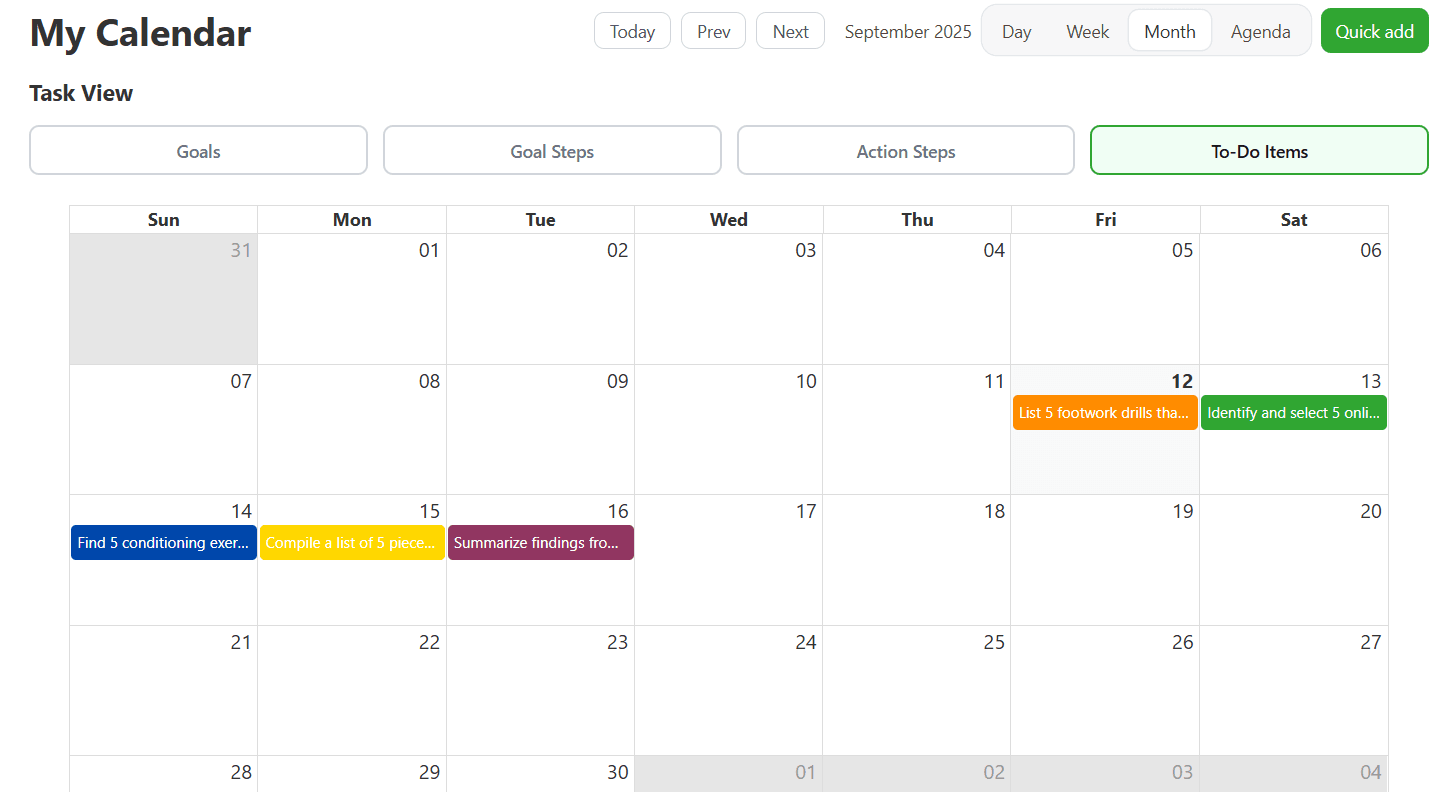
- Use the Filters button in the calendar workspace to switch between Planned, Everything, Personal events, Goals, Steps, Todos, and Baseline. Planned is the default mixed view and stays focused on scheduled work, while Everything includes baseline blocks like sleep or work as well.
- Goal, step, action step, and todo blocks include a small arrow inside the calendar pill. Use it for quick actions: see the scheduled time range, log today's work without finishing the whole item, or open the completion flow for the item itself.
- Click or tap an empty slot in month, week, or day view to open the Create event modal with that date and time prefilled.
- Desktop supports drag and resize for calendar blocks. On mobile, drag-and-drop is turned off so vertical page scrolling stays reliable; use tap to open an event and the edit controls to change timing.
- When you enter a specific local time such as 06:00 or 22:30, Calendar saves that exact wall-clock time in your selected timezone. Baseline blocks like sleep should round-trip back to the same local time you entered.
- Calendar follows one shared time contract across events, goals, todos, baseline rules, reminders, and scheduling agents: your timezone is the source of truth, explicit local times should stay exact, month-view drag should change the day but not the time, and week/day drag should match the visible slot you chose.
- No-overlap checks use real scheduled time blocks. They should not be triggered by the longer all-day execution overlays that summarize Today's Actions across multiple days.
- New personal events use a broader calendar color palette by default, and you can override the color in Add Event, Edit Event, or step/todo schedule editing using the preset swatches or the visible color wheel. Auto color also shows a preview so you can see the default before saving.
- Use Quick add for one-line entry (for example: "doctor tomorrow 8:30am for 45m" or "doctor this Friday at 6am for 1 hour"). Quick add ignores leading command words like "add/schedule/create", supports common tomorrow typos like "tommow", handles overnight ranges (for example: "sleep 10:30pm to 6:00am"), and asks you to clarify bare weekdays as "this Friday" or "next Friday".
- Use Recent changes to review the last applied edits and Undo a change set in one click if something landed in the wrong place.
- Use the toolbar buttons for Sync, Actual/Ideal mode, Filters, Utilities, Add event, and AI without leaving the calendar workspace.
- Month view auto-expands as needed so end-of-month dates are always visible and not clipped.
- Use the Add/Edit event modal sections (Basics, Time, Rules) to keep entries clean; when you toggle All day, time inputs hide automatically.
- After each confirmed change, watch for the inline "Added ..." update badge and highlighted event block so you can verify placement instantly.
- If no-overlap mode blocks a change, use the Conflict resolver card to choose Move new block, Replace old block, or Allow once.
- When deleting a recurring event, choose the scope clearly: This one, This and future, or All in series.
- Use the inline "Why" explanations in suggestions/previews to understand why a slot or change was suggested before you confirm.
- Review priority tags and adjust high-load windows.
- Run an on-demand sync if external changes were made elsewhere.
What good looks like
- Daily priorities have protected time blocks on calendar.
- Overlaps are intentional and limited, not accidental.
- Adjacent items with different names are visually separated by color, while matching names keep a consistent default color.
- Goal sessions appear consistently in your real week.
Common issues and fixes
- Missing events: run a manual sync and verify integration is active.
- Wrong event times: check profile timezone and provider timezone.
- Too many overlaps: use Calendar AI and reduce same-window load.
- Can't find Fitbit sync in Calendar: use the Fitbit integration card on Performance.
Related help
Screenshots